Norwegian Foot March Standards & Ruck March Pace Calculator
Time limits from the Norwegian guidelines, converted to a per-mile pace and a stop budget.
Reviewed against official sources
18.64 mi (30 km) with ≥ 24.25 lb (11 kg) pack
Checkpoint splits
Even pace to the 4:30:00 limit vs your projected time
| Checkpoint | Miles | Limit pace | Your pace | Buffer |
|---|---|---|---|---|
| 5 km | 3.1 | 45:00 | 41:40 | +3 min |
| 10 km | 6.2 | 1:30:00 | 1:23:20 | +7 min |
| 15 km | 9.3 | 2:15:00 | 2:05:00 | +10 min |
| 20 km | 12.4 | 3:00:00 | 2:46:40 | +13 min |
| 25 km | 15.5 | 3:45:00 | 3:28:20 | +17 min |
| 30 km | 18.6 | 4:30:00 | 4:10:00 | +20 min |
Age groups follow the NFM 2025 guidelines; the pack must weigh at least 11 kg dry, excluding water and food.
Norwegian Foot March Standards: Distance, Rucksack and Time
The Norwegian Foot March (Marsjmerket) is 30 km, 18.64 miles, carrying a pack that weighs at least 11 kg (24.25 lb) dry, without water or food. The time limit depends on age and sex, and it is set by the Norwegian standard, not by the U.S. host unit.
Men aged 21–34 have 4 hours 30 minutes, an average of 14:29 per mile. Women of the same age have 5:15, or 16:54 per mile. The limit loosens with age: men 60 and over have 5:15 and women 60 and over have 6:00.
The average pace includes every stop. Two 10-minute breaks on a 4:35 limit leave 4:15 of moving time, which means walking at 13:41 per mile, close to a brisk hike with a pack.
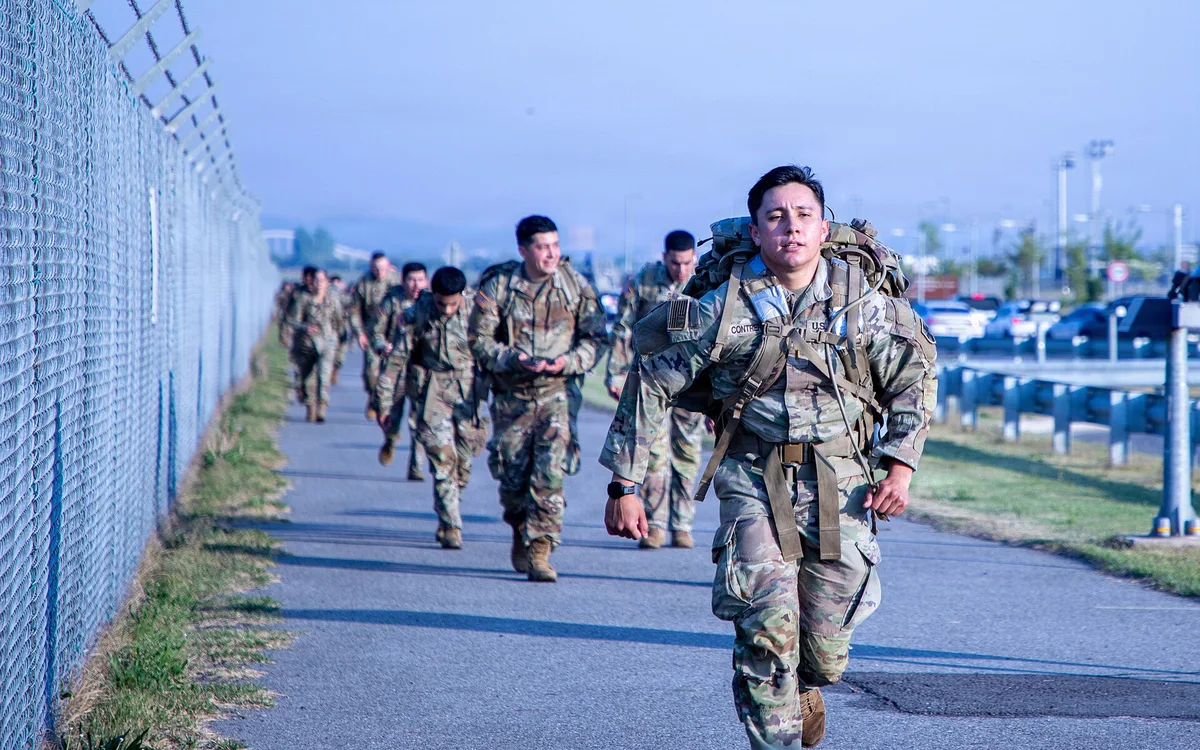
How to Earn the Norwegian Foot March Badge
Participants cover 30 km (18.6 miles) carrying a rucksack with a dry weight of at least 11 kg (24.25 lb), inside the time limit for their age and sex. The rucksack is weighed before the start and again after the finish line, so a pack that drops under the minimum 11 kg along the route does not qualify. Weighted vests, body armor and plate carriers do not count toward the weight; organizers may let a carried rifle count.
Military participants march in their service’s combat uniform and boots. Civilian participants can earn the badge too: they wear clothing similar to a combat uniform, with long pants and boots, and may carry a civilian hiking backpack instead of an issued rucksack.
Badge grades follow the number of completed marches: bronze for the first, silver for the second through fourth, and gold for the fifth or more. Each participant may complete only one march per calendar year. After the event, the embassy sends the organizer a certificate template to fill in for every finisher.
Approved Events and the Norwegian Embassy
Since 2021 a Norwegian officiant no longer has to attend, but every event must be endorsed by a Norwegian military official. For marches run by foreign military units, the Office of the Defence Attaché at the Royal Norwegian Embassy reviews a request packet (route map, weighing and attire check area, water points and medical plan) and usually answers within two to four weeks.
Approved routes are out-and-back (15 km each way) or no more than three 10 km loops, with distance markers every 5 km and at least three water points. The march cannot go ahead if the shade temperature is above 25 °C (77 °F) or below −15 °C (5 °F). Only endorsed events lead to the certificate, so confirm the endorsement before you register.
Wearing the Badge on a U.S. Uniform
For U.S. Army Soldiers the Norwegian Foot March badge is a foreign badge. AR 600-8-22 covers accepting and recording foreign badges, and AR 670-1 with DA Pam 670-1 sets placement: it is authorized for wear on the service uniform, not on the OCP duty uniform, and only one foreign badge may be worn at a time. Take the certificate to your S1 so the badge is recorded before you wear it.
The Norwegian guidelines allow non-Norwegian military personnel to wear a badge up to 39 mm (1.5 in) tall. Airmen, Sailors and Marines follow their own service’s uniform rules for foreign badges.
Ruck Weight and Foot Care Preparation
Train with the load you will carry. Build up over several weeks to ruck marches of 15–25 km with a dry pack slightly above 11 kg, so the test-day ruck weight feels familiar, and taper the final week before the march.
Feet decide most long marches. March in broken-in boots, wear moisture-wicking socks and carry a spare pair, tape known hot spots before the start, and treat rubbing at the first water point instead of waiting for the finish.
Norwegian Foot March Time Limits by Age and Sex
| Age | Men | Men pace / mi | Women | Women pace / mi |
|---|---|---|---|---|
| 18–20 | 4:35 | 14:45 | 5:25 | 17:26 |
| 21–34 | 4:30 | 14:29 | 5:15 | 16:54 |
| 35–42 | 4:35 | 14:45 | 5:25 | 17:26 |
| 43–49 | 4:40 | 15:01 | 5:30 | 17:42 |
| 50–54 | 4:50 | 15:33 | 5:40 | 18:14 |
| 55–59 | 5:00 | 16:06 | 5:50 | 18:47 |
| 60+ | 5:15 | 16:54 | 6:00 | 19:19 |
Ruck march pace example: 38-year-old man with two rest stops
Age 38 (35–42 group), limit 4:35 = 275 minutes.
- Average pace allowed: 275 ÷ 18.64 = 14:45 per mile.
- Plan two 10-minute stops: 275 − 20 = 255 minutes moving.
- Moving pace needed: 255 ÷ 18.64 = 13:41 per mile.
- Split check: the 9.32-mile halfway point should come at or before 2:07:30 of moving time.
Walking at 13:30 per mile with two 10-minute stops finishes in about 4:32, inside the 4:35 limit with roughly 3 minutes to spare.
Ruck Weight, Age Group and Finish Time Edge Cases
What if I turn 21 before the march?
A 20-year-old man whose birthday falls two weeks before the event.
Result: Moving from 18–20 to 21–34 cuts the limit from 4:35 to 4:30 for men and from 5:25 to 5:15 for women. Confirm in the host packet which date sets your age group.
What if my pack weighs 11 kg only with water?
Pack is 9.5 kg plus 1.5 kg of water.
Result: The 11 kg minimum is dry weight. Water and food do not count, so the pack is underweight and the march does not qualify.
What if I finish one minute over the limit?
Man aged 25 finishes in 4:31.
Result: The badge is pass/fail against the limit. There is no rounding or partial credit; 4:31 does not qualify for the 21–34 group.
Norwegian Foot March Badge FAQ
How difficult is the Norwegian Foot March?
It is 18.64 miles with at least 24.25 lb, and most age groups must average 14–17 minutes per mile including stops. For most participants pacing and foot care matter more than strength.
What pace do you need for the Norwegian Foot March?
Men 21–34 need 14:29 per mile on average and women 21–34 need 16:54. Moving pace must be faster if you plan to stop.
Can anyone do the Norwegian Foot March?
The Norwegian guidelines cover both military and civilian participants, with separate attire rules for each. Each host event still decides who may register, so read the host’s instruction packet first.
How do you earn the Norwegian Foot March badge?
Finish 30 km with a rucksack of at least 11 kg dry weight, checked at the start and finish line, inside your age and sex time limit at an embassy-endorsed event. First completion earns bronze, the second to fourth silver, the fifth or more gold.
Can I wear the Norwegian Foot March badge on my Army uniform?
Yes, as a foreign badge on the service uniform once it is recorded under AR 600-8-22. It is not worn on the OCP uniform, and only one foreign badge may be worn at a time.
What is the success rate of the Norwegian Foot March?
No official success rate is published by the Norwegian organizers. Pass rates vary by event, weather and preparation, so treat any single figure you see as anecdotal.
Related tools
Official sources
- Norwegian Foot March guidelines 2025, v1.7Norwegian Ministry of Foreign Affairs / Norwegian Armed Forces
- CRDAMC Norwegian Foot March challengeU.S. Army
- 2025 NFM instructions, MacDill AFBU.S. Air Force
* Photo: U.S. Army 2ID / Pfc. Junseo Koh, Public Domain